
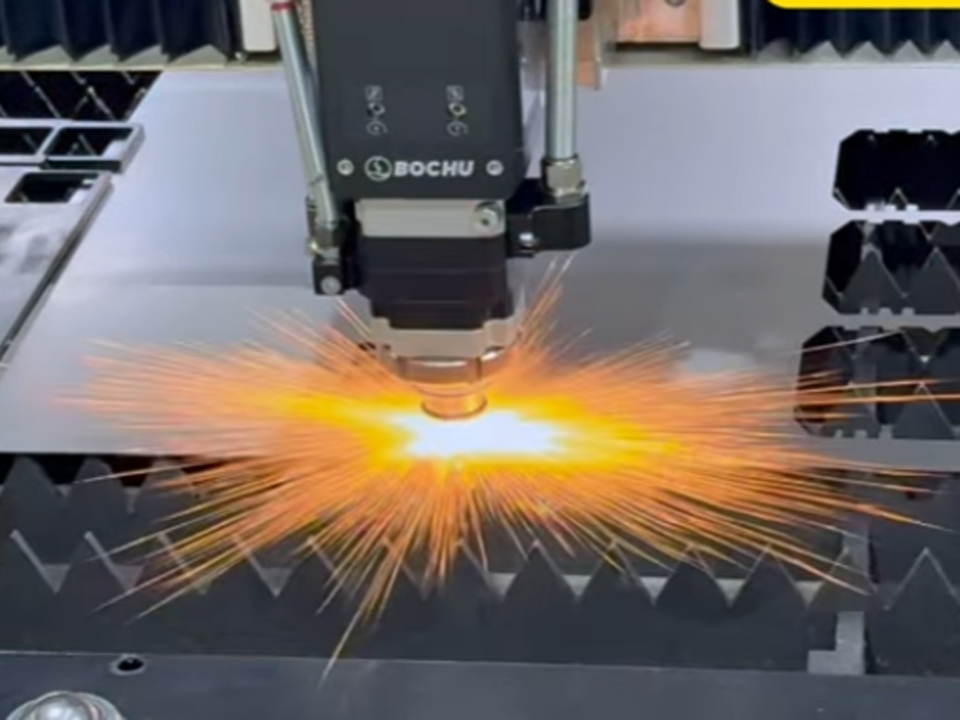
Découpe laser des métaux vs méthodes de fabrication traditionnelles
Découpe au laser à fibre optique vs découpe au plasma, au jet d'eau, par poinçonnage et par cisaillage : comparaison, destinée aux acheteurs, des tolérances, des limites d'épaisseur, des effets thermiques, des facteurs de coût et de la préparation des appels d'offres.

Laser metal cutting is usually the better fit for thin-to-medium sheet and tube parts that have complex profiles, tight fit-up requirements, or designs that change from one order to the next. Traditional methods such as plasma cutting, waterjet cutting, turret punching, shearing, and sawing still win in specific situations: thick structural plate, straight blanks in volume, parts that need formed features, and alloys that cannot tolerate heat. The right choice depends on material, thickness, batch size, edge requirements, and what happens to the part after cutting. This guide compares the main processes on those terms. It is written for fabrication shop owners, production managers, and procurement teams who are deciding whether to buy a fiber laser, keep outsourcing, or keep a mixed process line.
What Is Laser Metal Cutting, and How Does It Differ from Traditional Methods?
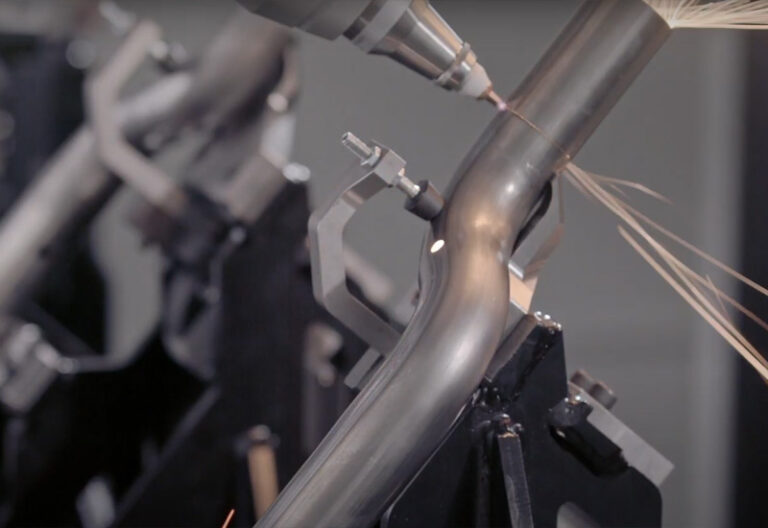
Laser metal cutting directs a focused, CNC-controlled beam along a programmed path. In fiber laser systems the beam melts and vaporizes the metal, and an assist gas blows the molten material out of the cut. One sheet metal service provider’s cutting guide notes that nitrogen is typically used for stainless steel and aluminum, and oxygen for mild steel.
“Traditional fabrication” covers three different families of process:
- Mechanical cutting: shearing, punching, and sawing. A tool contacts the metal and removes or separates it by force.
- Thermal cutting: plasma and oxy-fuel. Heat and gas velocity melt and clear the metal, but the kerf and heat input are larger than with a laser.
- Abrasive cutting: waterjet. Water mixed with garnet abrasive erodes the material with no heat input.
The practical difference for a buyer is tooling. Laser, plasma, and waterjet all cut from a CAD file with no part-specific tooling. Punching needs punch-and-die sets, and shearing is limited to straight lines. That single difference drives most of the cost and lead-time gap on short runs and design changes.
Laser Cutting vs Plasma, Waterjet, Punching, and Shearing: Side-by-Side
The table below uses the ranges published in the cutting guide cited earlier. Treat the figures as typical values from one provider, not as standards or guarantees. Real results depend on machine condition, power, material grade, and programming.
| Processus | Typical thickness range (steel unless noted) | Typical tolerance | Heat effect on edge | Part-specific tooling | Meilleure adéquation | Main limitation |
|---|---|---|---|---|---|---|
| Laser à fibre | 0.5–25 mm | ±0,05 mm | Thermal; low burr | Aucun | Complex profiles, prototypes, short and mixed runs | Speed and quality fall off on very thick plate; reflective metals need tuning |
| Plasma | 3–50 mm+ | ±0.5–1.0 mm | Visible HAZ and dross | Aucun | Thick structural plate | Wider kerf; poor proportion on thin sheet |
| Jet d'eau | 0.5–150 mm+ | ±0.1–0.2 mm | Aucun | Aucun | Heat-sensitive alloys, composites, thick material | Slower per part; abrasive and pump costs |
| CNC turret punching | 0.5–6 mm | ±0.1 mm | Mechanical | Punch-and-die sets | High hole counts, formed features, volume | Tooling cost and lead time; limited thickness |
| Shearing | Up to 6 mm | ±0.2–0.5 mm | Mechanical | Lames | Straight blanks at high volume | Straight cuts only |
| Band saw / chop saw | Bars, tubes, sections | ±1–3 mm | Minime | Aucun | Cutting stock to length | Rough edges, low precision |
Tolerance and Edge Quality
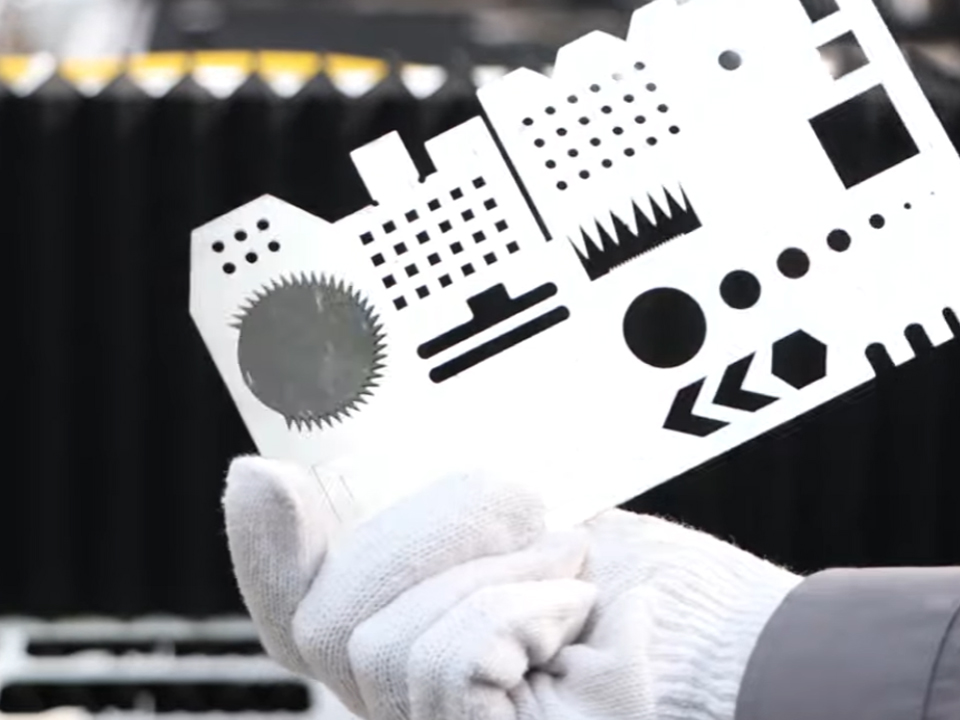
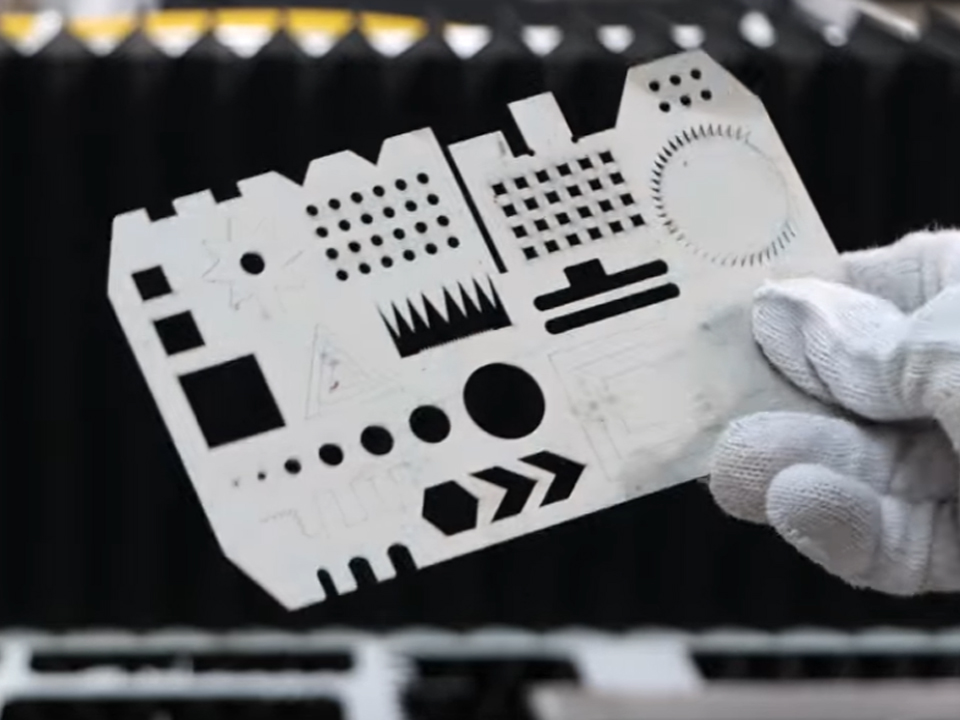
Laser cutting holds the tightest tolerance in this comparison, but “tolerance” needs careful reading. The product pages for BOGONG’s sheet-and-tube combination cutter and its compact 3030 cutter both list positioning accuracy of ≤±0.03 mm and repeatability of ≤±0.02 mm. Those are supplier-stated machine motion specifications. They describe how accurately the axes move, not the tolerance of a finished part. Part accuracy also depends on material flatness, thermal distortion in thin or narrow features, focus position, nozzle condition, assist gas, and fixturing.
When you compare quotes, ask for achievable tolerance on your material, thickness, and feature size rather than a single headline figure.
Setup Time and Tooling
Laser cutting from a DXF file can start without waiting on tools, whereas turret punching may need custom tooling with a lead time of one to two weeks, according to the same guide. This matters most for prototypes, spare parts, and customers who revise drawings often. For a stable part made in large quantities with many holes, punching can remain competitive because it removes the cutting time per hole and can form features in the same stroke.
Heat-Affected Zone and Downstream Processing
Laser, plasma, and oxy-fuel are thermal processes, so all of them create some heat-affected zone (HAZ). The question is how much, and what the edge needs afterward. Plasma leaves a more visible HAZ and dross that often needs grinding on fit-critical surfaces. Waterjet adds no heat at all.
The assist gas choice has a downstream consequence that many first-time buyers miss. According to the RapidDirect guide to cutting sheet metal, oxygen-assisted cutting of stainless steel leaves an oxide layer that must be ground off before welding, while nitrogen gives an oxide-free edge. Nitrogen costs more per cut, so the cheaper gas is not always the cheaper process once weld preparation is counted.
Material Utilization and Operating Cost
A narrower kerf and the absence of part-specific tooling let a laser nest parts closely on the sheet, which reduces scrap on small and irregular parts. The size of the saving depends on part geometry, so calculate it from your own nests instead of relying on a general percentage.
Operating cost needs the same care. A laser consumes electricity, assist gas, optics, and nozzles. Plasma consumes electrodes and nozzles. Waterjet consumes abrasive and requires pump maintenance. Punching consumes tooling that wears and needs resharpening. The comparison that matters is cost per finished part, including secondary operations, not cost per meter of cut.
Where Traditional Methods Still Make Sense
A common assumption is that a fiber laser should replace every other cutting process in a modern shop. That holds for thin and medium sheet. It breaks down in several cases:
- Thick plate. Above roughly 25 mm on steel, the guide reports that laser cut quality and speed drop off, and plasma or waterjet takes over. Higher laser power extends the range, but the economics change with thickness.
- Heat-sensitive materials. Titanium brackets, hardened tool steels, and nickel alloys such as Inconel are typical waterjet work when any thermal change at the edge is unacceptable.
- Forming in the same operation. Turret punching can create louvers, countersinks, and embosses that a laser cannot make.
- Straight blanks in volume. A shear is fast and simple for straight cuts.
- Cutting stock to length. A saw is usually the practical choice for bars and structural sections.
An illustrative example: a shop that makes 3 mm stainless enclosures in batches of 50 with frequent drawing changes gains a lot from laser cutting. The same shop making 20 mm structural brackets in quantity may find plasma cheaper per part, because edge precision matters less. This is a hypothetical comparison, not a customer case.
The better approach for many fabricators is a mixed process line in which each part goes to the cheapest method that meets its specification.
Material Suitability for Fiber Laser Cutting
Material mix often decides whether a laser purchase makes sense. The ranges below come from the same cutting guide and are indicative only.
| Matériau | Typical fiber laser range | What to verify with the supplier |
|---|---|---|
| Acier doux | 0.5–25 mm | Oxygen vs nitrogen cutting; edge finish needed for painting or welding |
| Acier inoxydable | 0.5–20 mm | Nitrogen consumption and gas supply; weld-ready edge requirement |
| Aluminium | 0.5–12 mm | Dross behavior and cutting parameters for your alloy and thickness |
| Copper and brass | 0.5–5 mm | Laser power, back-reflection protection, and test cuts on your material |
| Gold and silver (jewelry) | Thin sheet; supplier-specific | Fixturing, kerf loss on precious metal, and recovery of scrap |
Reflective metals deserve extra attention. Copper and brass need more power and careful parameter tuning, and not every shop runs them. Buyers of small-format machines for jewelry and decorative work can review the plus petite machine de découpe laser à fibre pour le laiton, l'or et l'argent. The product page describes a 300 × 300 mm cutting size, a fully enclosed cabinet, and power options from 1000 W to 3000 W. It states that the machine cuts gold, silver, copper, and stainless steel. As with any supplier claim, request test cuts on your own material and thickness before ordering.
Sheet-Only or Sheet-and-Tube: Choosing a Machine Configuration
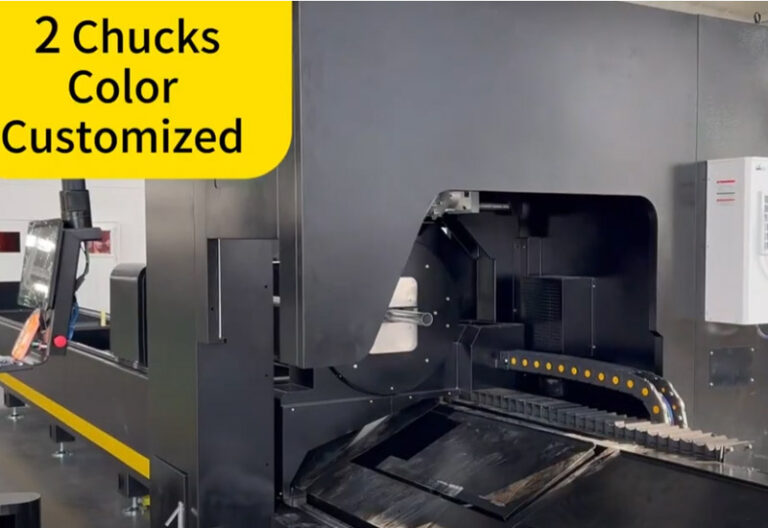
If your work includes both flat parts and tubular parts, a combination machine can save floor space and capital. The sheet and tube combo fiber laser cutting machine from BOGONG is listed with power options from 1500 W to 10,000 W, three-phase 380 V supply, and tube processing with common diameters from 20 mm to 200 mm. The page also mentions bevel cutting, drilling, and slotting. These are supplier-stated capabilities, so confirm them against your own tube sizes and wall thicknesses.
Three trade-offs deserve attention before you choose a configuration:
- Shared uptime. One machine doing both jobs becomes a bottleneck if sheet and tube demand are both high. Two dedicated machines add floor space and cost but allow parallel production.
- Power level. More wattage extends the thickness range, but it does not automatically improve results on thin material. It also raises electrical, cooling, and gas requirements.
- Tube work share. If tube cutting is only occasional, a sheet machine with outsourced tube work may cost less than the integrated system.
After Cutting: Marking, Engraving, and Traceability
Cutting is rarely the last step. Parts often need serial numbers, barcodes, logos, texture, or relief work, and that is where laser marking and engraving machines complement a cutting line. These are separate machine types from cutters, and they should not be treated as substitutes for a cutting machine.
- Serialization and traceability. Le Machine de marquage laser à fibre 30W is described as a compact all-in-one marker for logos, barcodes, and serial numbers on metals such as stainless steel, titanium, aluminum, copper, and brass. This suits batch identification for cut components.
- Relief and texture on metal. Le Graveur laser 3D à fibre pour le métal is positioned for deep engraving of textures and reliefs on metal molds, which is relevant for shops that also produce tooling or decorative parts.
- Larger marking areas. A large-area 3D fiber laser engraver is listed with marking areas from 300 × 300 mm up to 800 × 800 mm. The supplier itself advises that 3D relief work suits small, precise designs, and that buyers should not expect the machine to replace a CNC router on large relief jobs.
- Non-metal components. Assemblies often include plastic or glass parts. A Machine de marquage laser UV 3D is listed for marking glass and plastic on curved or irregular surfaces.
- Firearm component texturing. For stippling and grip texturing on metal, carbon fiber, and polymer parts, the supplier lists a Machine à graver les pistolets à fibre laser. Marking and licensing rules for firearms differ by jurisdiction, so buyers should check local requirements before investing.
What to Check When Evaluating a Laser Cutting Supplier
Use these criteria to compare suppliers, whether you are buying equipment or outsourcing parts:
- Test cuts on your material. Request sample parts in your grade and thickness, with edge and tolerance measurements.
- Clear specification definitions. Ask whether stated accuracy refers to axis positioning or to finished part tolerance.
- Laser source and power options. Confirm the source brand, power, and warranty terms in writing.
- Safety design. Ask for the laser safety classification, enclosure design, and any certification documents your market requires.
- Consumables and spares. Get a list of nozzles, lenses, and protective windows, with expected replacement intervals.
- Gas and utility needs. Confirm assist gas type, purity, flow, cooling, and electrical supply.
- Training and after-sales support. Find out how remote support works across time zones and who handles warranty claims.
What Should Buyers Specify Before Requesting a Quote?
A precise request gets a precise quote. Prepare the following:
- Materials and grades, such as carbon steel, 304 stainless, 5052 aluminum, or brass, and whether you cut reflective metals regularly.
- Thickness range and the thickest material you will cut in volume. Thickness drives power selection and price more than any other variable.
- Maximum sheet size, tube diameters, and wall thicknesses.
- Order quantity and batch size, so the supplier can judge nesting, loading, and automation needs.
- Critical tolerances, tied to specific features on a drawing.
- Edge requirements, such as weld-ready, paint-ready, or burr-free.
- Secondary operations, including marking, bending, and welding, so the process line is planned as a whole.
- Site conditions, including voltage, single or three-phase power, and gas supply.
- Sample drawings for test cutting.
When these details are ready, send your drawings and material list to the supplier and ask for a configuration recommendation with test-cut results for your most demanding part.
Questions fréquemment posées
Is laser cutting better than plasma cutting for sheet metal?
For thin and medium sheet, laser cutting generally gives tighter tolerances, cleaner edges, and less secondary finishing. Plasma is usually more economical for thick structural plate where edge precision matters less. The right choice depends on thickness, material, and part requirements.
What thickness can a fiber laser cut compared with other methods?
One published guide gives about 0.5–25 mm for mild steel on a fiber laser, 3–50 mm or more for plasma, and 0.5–150 mm or more for waterjet. Actual limits depend on laser power, material, and required edge quality.
Does laser cutting create a heat-affected zone?
Yes. Laser cutting is a thermal process, so some HAZ is always present. It is generally narrower than plasma on thin sheet. Waterjet cutting adds no heat. Ask your supplier to verify edge quality on your material.
Can a fiber laser cut brass, copper, gold, and silver?
Fiber lasers can cut these metals, but reflectivity makes them harder than steel. They typically need higher power, tuned parameters, and sometimes back-reflection protection. Maximum thickness is lower, so request test cuts on your material.
Do I still need a punch press or shear after buying a laser cutter?
Often yes. Punching can form louvers and embosses that a laser cannot produce, and shearing is fast for straight blanks in volume. Many shops keep a mixed process line and send each part to the cheapest suitable method.
Can a laser marking machine cut metal?
Marking and engraving machines are designed for surface marking, serial numbers, and relief work, not for cutting sheet or tube. For cutting, you need a fiber laser cutting machine with suitable power and a cutting head.
What should I send a supplier to get an accurate laser cutting quote?
Send material grades, thickness range, sheet or tube dimensions, batch sizes, critical tolerances, edge requirements, secondary operations, local power supply, and sample drawings. These details determine power, table size, gas requirements, and price.



Hot Click
Nous contacter
Application
©Copyright [bogonglaser.com]. BOGONG Laser Machine Supplier Tous droits réservés.