
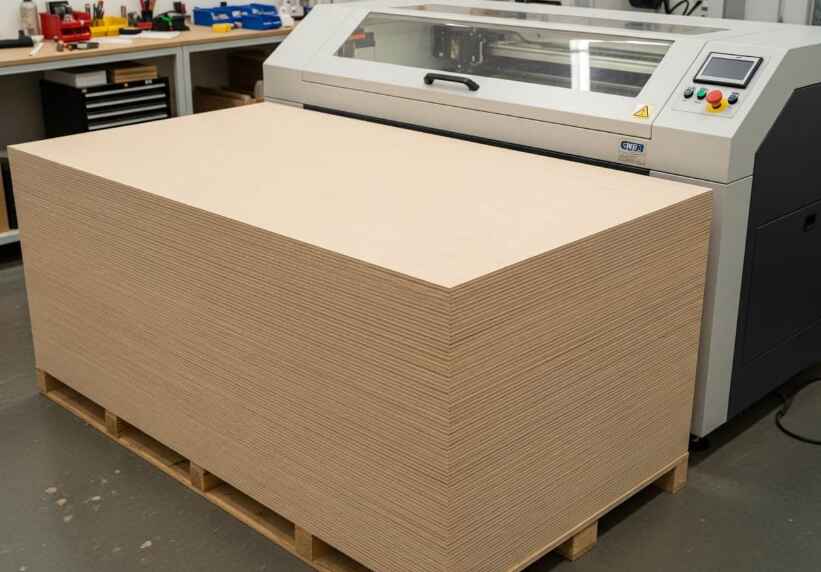
How CO2 Laser Cutting Machines Process Wood Materials
CO2 laser cutting wood is not magic. It is controlled thermal damage: a focused infrared beam heats cellulose, lignin, adhesive, and moisture until the material vaporizes, chars, or fractures along a programmed path.

The Dirty Secret: A CO2 Laser Does Not “Cut” Wood Like a Saw
Heat does it.
A CO2 laser wood cutting machine is not slicing fibers with a blade; it is forcing a narrow thermal event into cellulose, hemicellulose, lignin, glue lines, resin pockets, moisture, and air gaps, then using motion control and exhaust airflow to keep that controlled burn from becoming a ruined edge. Sounds less romantic, right?
I’ll be blunt: most bad advice about CO2 laser cutting wood comes from people who treat “wood” as one material. It is not. Basswood, birch plywood, MDF, bamboo, walnut, rubberwood, and veneered board all behave differently under the same beam. The operator who ignores that fact gets smoke staining, glue flare-ups, uneven kerf, brown edges, and parts that smell like a campfire trapped inside a shipping box.
The reason CO2 works so well on wood is wavelength. A typical CO2 laser operates at 10.6 µm, an infrared wavelength strongly absorbed by organic materials; Bogong’s own CO2 laser engraver cutter lists CO2 tube options and a 10.6 µm laser tube specification, which is exactly the range used for non-metal cutting and engraving work.
That matters because wood does not need brute force. It needs energy density, clean focus, correct speed, stable air assist, and honest ventilation. If you only shop by wattage, you are already halfway to buying the wrong machine.
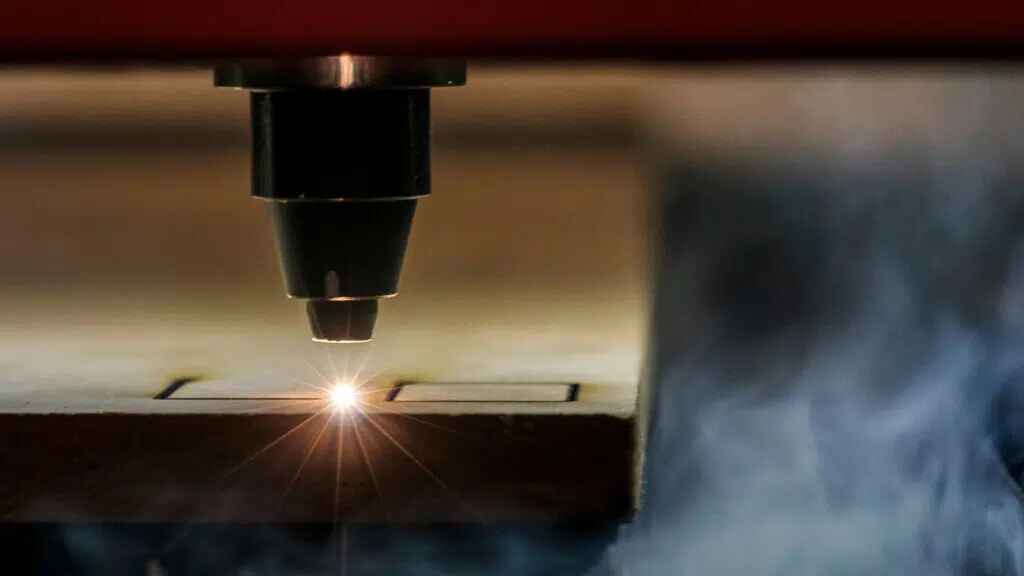
Table of Contents
How CO2 Laser Cutting Works on Wood: The Real Process
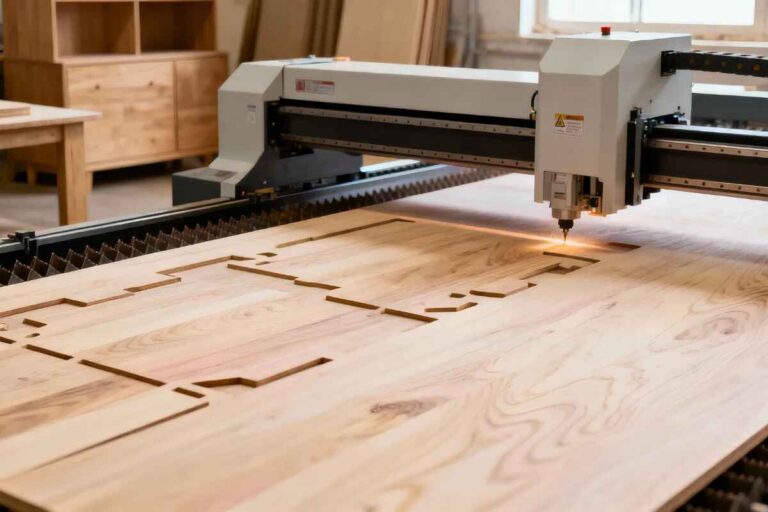
A CO2 laser cutting machine processes wood by focusing a 10.6 µm infrared beam into a small spot that rapidly heats the surface, decomposes organic material, vaporizes moisture, chars lignin, and ejects smoke through air assist and exhaust while the motion system follows a digital cutting path.
That is the clean definition. The uglier reality is this: every cut is a negotiation between beam power, feed speed, focal height, wood density, adhesive chemistry, moisture content, and airflow.
Step 1: The design file becomes motion data
The wood laser cutting process starts with a vector file, usually DXF, AI, SVG, or similar CAD artwork. The controller converts that geometry into movement instructions: lines, curves, pierce points, speed values, power percentages, and cut order. On production machines, software such as RDWorks or Ruida-based control systems is common; Bogong’s CO2 product page specifically references RDWorks and USB/Ethernet connectivity in its machine specifications.
This is where beginners make a quiet mistake. They obsess over the beam and ignore cut sequencing. If you cut tiny internal features after freeing the outer profile, the part can shift. If you overcut tight corners, resin burns. If you run dense engraving before cutting, the board absorbs heat and warps.
Step 2: The beam focuses energy into the kerf
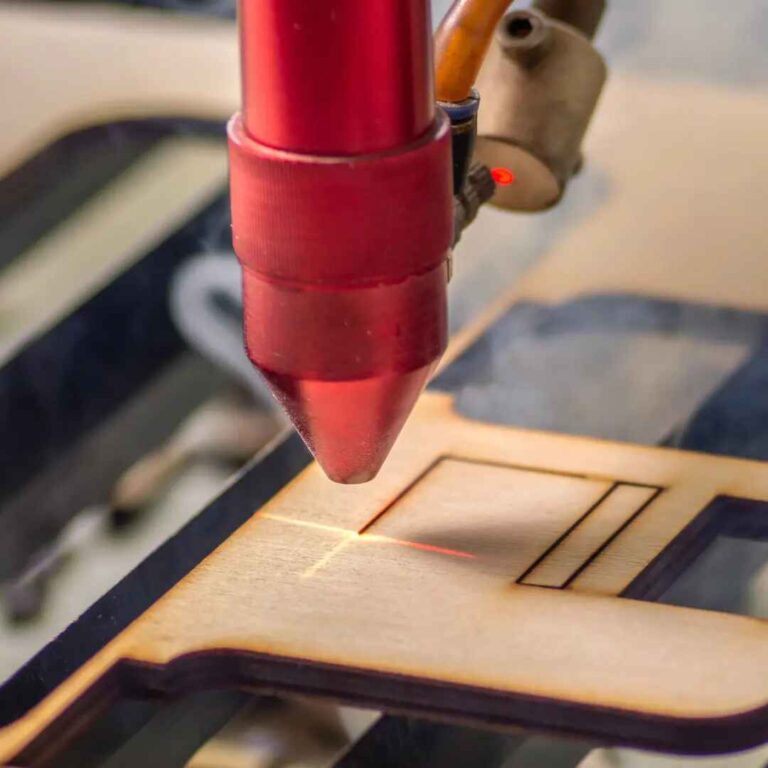
The kerf is the width of material removed by the laser. In wood, that kerf is not only vaporized fiber; it is char, ash, gas, and micro-cracking. A sharper focus gives a narrower kerf and cleaner detail, but only if the material is flat. Warped plywood is the enemy. So is cheap MDF with inconsistent density.
For thin craft plywood, a 60W–100W CO2 laser can often cut cleanly when the optics are aligned. For thicker MDF or production plywood, 100W–150W becomes more practical because speed matters. Bogong’s wood/MDF guide lists 40W–150W for CO2 engraving cutting machines and notes CO2 suitability for wood, MDF, leather, and acrylic.
But power is not permission to be careless. More wattage can mean more heat-affected zone, more smoke, more edge carbonization, and more fire risk.
Step 3: Wood decomposes before it disappears
Wood is mostly cellulose, hemicellulose, and lignin, with water and extractives mixed in. When the beam hits, moisture flashes off first. Then thermal decomposition begins. The surface darkens. Volatile organic compounds leave the cut zone. Char forms. The beam continues downward if enough energy reaches the lower fibers.
This is why plywood laser cutting behaves differently from solid basswood. Plywood has glue layers. MDF has resin and compressed fiber. Hardwood has grain density changes. Bamboo chars aggressively. Veneer can lift. The beam sees all of this, even when the operator pretends the board is “just 3 mm wood.”
Step 4: Air assist decides whether the edge is acceptable
Air assist is not decoration. It pushes smoke out of the beam path, cools the cut zone, reduces flare-ups, and helps eject debris. Weak air assist leaves a dirty beam path. Too much air can overcool the kerf or blow soot across the surface. The boring answer is the true one: you test.
In 2024, a desktop laser cutter emissions study indexed by the CDC examined laser cutting and engraving across cardboard, wood, plastic, and glass at 10 amp, 15 amp, and 20 amp settings while measuring respirable particles, sub-half-micron particles, VOCs, and carbon monoxide. The study’s abstract states that airborne contaminants from laser cutting include respirable particulates and VOCs that pose health risks, and it specifically evaluated exhaust ventilation as part of the test matrix.
That is the part many sellers skip. Wood cutting is a fume-management problem disguised as a precision-cutting problem.
Wood Materials Under the Beam: What Burns Cleanly, What Betrays You
Wood is evidence.
If I had to separate competent operators from hobbyists, I would not ask them what machine they bought. I would ask what happens when they cut 6 mm birch plywood from two different suppliers using the same file. If they say “same result,” I stop listening.
Bogong’s laser cutting machine for wood page correctly frames wood cutting around plywood, MDF, hardwood, and softwood, with applications in furniture, cabinetry, signage, model making, and decorative work. That is the right grouping because material identity drives process behavior, not marketing category.
| Wood material | Typical CO2 laser behavior | Main risk | Practical operator move |
|---|---|---|---|
| Basswood | Cuts easily, pale edge, low resistance | Overburn on tiny details | Lower power, higher speed, fine air assist |
| Birch plywood | Good detail, stable sheet behavior | Glue-line flare and uneven cutting | Test every supplier batch before production |
| MDF | Smooth geometry, predictable density | Dense smoke, resin odor, brown edges | Strong exhaust, slower speed, clean lens schedule |
| Hardwood | Premium appearance, varied grain response | Uneven burn through dense grain | Adjust speed by species and thickness |
| Bamboo | Sharp engraving contrast | Aggressive charring and odor | Use masking, air assist, and conservative power |
| Veneered board | Attractive surface finish | Veneer lift, glue staining | Shallow pass tests before full cutting |
Plywood is the liar in the room
Plywood looks consistent. It is often not. Interior voids, glue pockets, overlapping plies, and resin-rich layers can interrupt the beam. One panel cuts like butter. The next produces a hot knot, a scorched edge, and a half-cut tab that snaps during assembly.
So when people ask for the best CO2 laser cutter for wood, I push back. The better question is: what material thickness, what sheet supplier, what daily production volume, what acceptable edge color, and what exhaust setup?
For businesses comparing platforms, Bogong’s CO2 laser cutting machine page is a relevant internal reference because it lists CO2 systems for acrylic, thin wood, and other non-metal materials, with 60W–180W CO2 technology options.
MDF cuts well, then punishes your ventilation
MDF is the great seducer. It is flat, cheap, uniform, and predictable. It also produces heavy smoke and resin-heavy fumes. If a supplier tells you MDF is “easy,” ask them about filtration, duct diameter, activated carbon, negative pressure, lens contamination, and shop odor complaints. Watch their face.
The U.S. EPA’s TSCA Title VI rules cover hardwood plywood, medium-density fiberboard, and particleboard, and the EPA states that after March 22, 2019, covered composite wood products must be labeled TSCA Title VI compliant; the same EPA page also references laminated product producer provisions extending to March 22, 2024.
That regulatory context matters for buyers who cut MDF, plywood, or particleboard for export products, retail goods, toys, furniture, displays, or packaging. The laser does not erase upstream material obligations.
The Machine Settings Nobody Wants to Put on the Sales Brochure
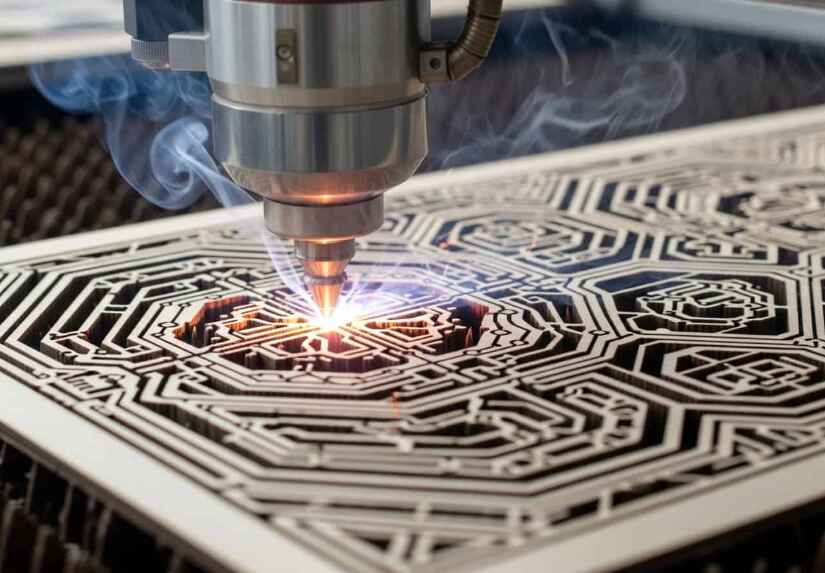
Here is the hard truth: settings tables are starting points, not gospel. The same “3 mm plywood, 80W, 18 mm/s” advice can succeed on Monday and fail on Friday if the board lot changes, the lens is dirty, the mirrors drift, or humidity changes.
A serious CO2 laser wood cutting machine should be evaluated on five shop-floor variables:
Beam quality
Cheap tubes can cut, but inconsistent beam quality shows up as wider kerf, uneven corners, and unstable engraving density. Better optics and alignment discipline matter more than beginners think.
Motion control
Wood does not forgive jerky acceleration. Tight curves, small slots, and interlocking joints expose vibration. If you are cutting decorative panels, model kits, or inlay parts, machine rigidity is not optional.
Exhaust and filtration
OSHA warns that wood dust becomes a health problem when particles from cutting and sanding become airborne, and it identifies respiratory symptoms and cancer among possible hazards.
For control, OSHA says engineering controls are preferred and typically include exhaust ventilation systems with collectors placed where dust is produced.
A laser cutter is not a sealed magic box. It is a smoke generator with a precision motion system attached.
Bed design
Knife beds reduce back reflection and contact staining. Honeycomb beds support small parts but can trap smoke and resin. Conveyor beds make sense for roll materials and repeated production. The wrong bed can ruin the underside of otherwise clean cuts.
Service reality
I care less about the brochure and more about replacement tubes, mirrors, lenses, chillers, belts, stepper drivers, controller boards, and response time. A down machine does not care how beautiful the sales video looked.
CO2 Laser Cutting vs CO2 Laser Engraving Wood
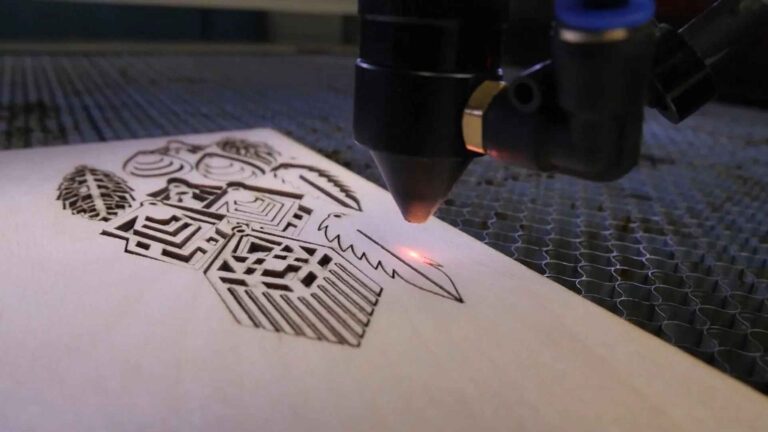
CO2 laser cutting wood removes material completely through the sheet, while CO2 laser engraving wood modifies the surface by burning, darkening, or texturing it without full penetration.
That distinction sounds simple until production starts. Cutting needs through-power and kerf control. Engraving needs tonal consistency and smoke control. The best jobs often combine both: engraved logos, scored fold lines, cut outlines, and shallow surface texture.
Bogong’s laser engraving machine for wood page describes engraving on hardwood, softwood, plywood, and MDF for logos, text, decorative patterns, furniture, artwork, and promotional items. That fits the real buying pattern: most shops do not buy a laser only to cut rectangles; they buy it to add margin through customization.
For example, a wooden gift-box factory may cut the box insert, engrave the brand mark, score fold locations, and personalize the lid on the same platform. The profit is not in the beam. It is in workflow compression.
Safety: The Part of Laser Cutting Wood That Separates Professionals From Gamblers
Never walk away.
That three-word rule is not superstition; it is the minimum adult behavior around focused infrared energy, smoke, dried wood, adhesive, and airflow. But here is the longer version: a CO2 laser cutter should be treated as a controlled fire process inside an interlocked enclosure, and the moment operators override interlocks, ignore smoke, skip lens cleaning, or cut mystery plastics on a wood schedule, the machine stops being a production tool and becomes a liability. Why gamble with a process that literally carbonizes organic material?
The University of Illinois Division of Research Safety says laser cutters are safe when used as designed with safety features in place, including interlocks, filtration and ventilation, standard operating procedures, and training.
I have a strong opinion here: ventilation is not an accessory. It is part of the cutting system. If the exhaust is weak, the beam path gets dirtier, the optics degrade faster, the edge gets darker, and the operator breathes what should have left the building.
And PVC? Do not cut it. Chlorinated materials can produce corrosive and dangerous gases. Treated wood, unknown laminates, painted boards, and adhesive-backed mystery sheets belong in a test-and-document workflow, not in casual production.
Choosing the Right Machine for Laser Cutting Wood Materials
The best CO2 laser cutter for wood is the machine that matches your material thickness, bed size, duty cycle, exhaust plan, service expectations, and finishing tolerance—not the machine with the loudest wattage claim.
For small signage, models, crafts, and personalized products, a compact CO2 laser engraver cutter can be enough. For furniture panels, decorative screens, architectural models, and repeated plywood laser cutting, you need larger working area, better exhaust, stronger chiller stability, and a bed that supports sheet handling.
Bogong’s laser cutting machine application page separates CO2 laser cutting machines for non-metal materials such as acrylic, leather, paper, and wood from fiber laser machines for metals, which is the right strategic split. A fiber laser is not automatically “better.” For wood, CO2 is usually the practical answer.
Here is the operator-first buying logic I would use:
| Buying factor | Weak choice | Better choice |
|---|---|---|
| Laser power | Buying maximum wattage blindly | Match wattage to thickness and edge quality target |
| Work area | Choosing the cheapest small bed | Size the bed around real sheet dimensions and nesting |
| Exhaust | Using a small fan as an afterthought | Design ducting, filtration, and makeup air early |
| Materials | Assuming all plywood cuts alike | Test each supplier, thickness, and glue type |
| Software | Treating control software as minor | Confirm file workflow, cut order, layers, and speed control |
| Support | Buying from a catalog with no process advice | Ask for sample testing, parameter guidance, and parts availability |
If you are comparing options, start with the CO2 laser engraver cutter for machine-level specifications, then move to laser cutting machine for wood for application fit. That internal path matches how serious buyers think: capability first, material behavior second, quote last.
How to Cut Wood With a CO2 Laser Without Producing Junk
If you want clean results, stop treating the first cut as production. Treat it as evidence.
Start with a material log. Record species, supplier, sheet thickness, moisture feel, surface finish, glue type if known, masking method, lens focal length, air pressure, speed, power, pass count, and edge result. Yes, it is boring. It also saves money.
My field-tested sequence, minus the mythology
First, test a small grid. Change only one variable at a time. Speed first, then power, then air assist. If the edge is too dark, increase speed or reduce power. If the cut does not go through, reduce speed before raising power. If the underside burns, inspect bed reflection and airflow. If engraving looks muddy, clean the lens and reduce smoke exposure.
Second, mask only when it helps. Paper transfer tape can protect the surface from smoke staining, but it may add cleanup labor. In high-volume production, the labor cost can exceed the cosmetic benefit.
Third, clean optics before blaming the machine. A dirty lens changes energy delivery. A misaligned mirror turns a “power problem” into a geometry problem.
Fourth, run extraction before the cut starts and after it ends. Smoke lingers. So does odor.
Fifth, quote finishing time honestly. Laser-cut wood often needs wiping, sanding, sealing, or odor control. If you ignore that, your margin estimate is fiction.
FAQs
What is CO2 laser cutting wood?
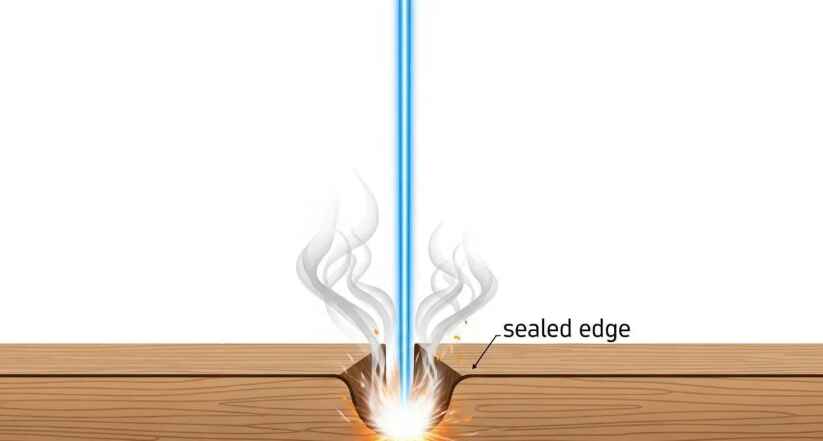
CO2 laser cutting wood is a thermal machining process where a focused 10.6 µm infrared beam heats wood fibers, moisture, resin, and adhesive layers until the material chars, vaporizes, and separates along a programmed toolpath. It is used for plywood, MDF, hardwood, softwood, signage, models, packaging, décor, and customized products.
In practical terms, the machine follows a digital vector file while air assist and exhaust remove smoke from the kerf. The quality of the result depends on beam focus, speed, power, wood density, glue chemistry, and ventilation.
How does a CO2 laser cutting machine process plywood?
A CO2 laser cutting machine processes plywood by heating and decomposing each veneer layer and adhesive line until the beam penetrates through the sheet, while air assist clears smoke and helps limit flare-ups. The result depends heavily on plywood grade, glue consistency, internal voids, sheet flatness, and moisture content.
Plywood is harder to standardize than many buyers expect. Two 3 mm birch sheets can cut differently if the core, adhesive, or storage conditions differ. Always test supplier batches before accepting a production job.
Is MDF safe to cut with a CO2 laser?
MDF can be cut with a CO2 laser, but it requires strong exhaust, suitable filtration, material verification, and careful operator discipline because compressed fiber and resin can produce dense smoke, odor, fine particulates, and chemical emissions. The cutting result is often geometrically clean, but the air-management burden is higher than with basswood or thin plywood.
The biggest mistake is treating MDF like harmless craft board. Check whether the board is compliant for your market, keep optics clean, and document ventilation performance before scaling production.
What power CO2 laser is best for wood cutting?
The best CO2 laser power for wood cutting is the lowest power that can cut the required thickness at acceptable speed, edge color, kerf width, and production reliability. Small crafts may run well around 60W–80W, while thicker plywood, MDF, and repeated commercial cutting often benefit from 100W–150W systems.
Do not buy wattage in isolation. A stable 100W machine with good optics, chiller performance, airflow, and service support can outperform a sloppy high-wattage machine in real wood production.
Why do laser-cut wood edges turn brown or black?
Laser-cut wood edges turn brown or black because the CO2 beam thermally decomposes cellulose, lignin, resin, and adhesive, leaving char along the kerf. Darkening increases when power is too high, speed is too slow, airflow is weak, optics are dirty, or the material contains resin-heavy glue lines.
Some edge color is normal. The goal is controlled, even coloration without excessive soot, flame marks, sticky residue, or undercut sections. Better air assist and supplier-specific settings usually improve the result.
Can the same CO2 laser machine cut and engrave wood?
The same CO2 laser machine can cut and engrave wood when it has suitable power control, motion accuracy, focusing optics, air assist, and software layer management. Cutting uses enough energy to pass through the sheet, while engraving uses controlled surface burning to create text, logos, photographs, patterns, and texture.
This is why CO2 machines are popular in gift manufacturing, signage, model making, packaging, and furniture branding. The value comes from switching between cutting and engraving without changing tooling.
Your Next Step: Test the Wood Before You Trust the Quote
If you are serious about laser cutting wood materials, do not ask only, “How much is the machine?” Ask what happens to your exact plywood, MDF, hardwood, bamboo, or veneer under the beam.
Send your material thickness, target product, expected daily output, workpiece size, and finish requirements to Bogong Laser through the laser machine quote and support page. Ask for a sample test, not just a price. The sample edge will tell you more truth than any brochure ever will.


Hot Click
Contact Us
Application
©Copyright [bogonglaser.com]. BOGONG Laser Machine Supplier All Rights Reserved.