
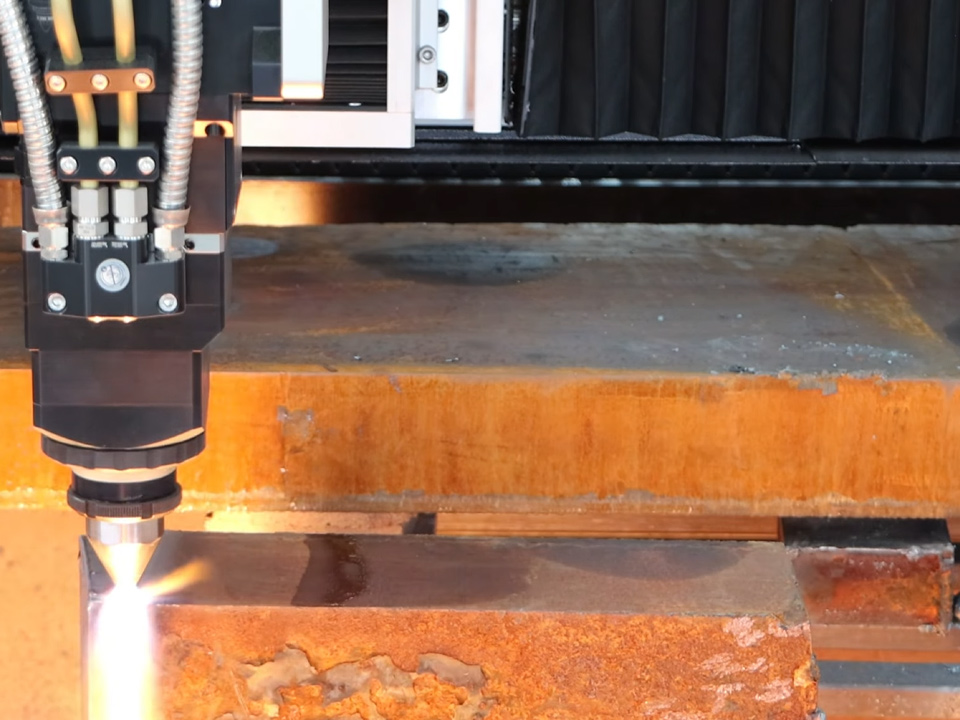
Fiber Laser Technology for High-Volume Server Manufacturing
Server manufacturing is no longer a slow, predictable business. AI racks, dense enclosures, tighter tolerances, and ugly margin pressure have changed the math. This article breaks down where fiber laser technology actually wins, where factories still lose money, and what high-volume server producers should care about before they buy another machine.

The server boom changed everything
Volumes got weird.
A few years ago, a lot of sheet metal shops could get away with slow quoting, lazy nesting, and a bit of hand-fixing after the cut, because server programs were steadier, model refresh cycles felt more predictable, and customers tolerated more nonsense between drawing release and finished chassis. That window is gone now. Completely gone.
And honestly? Good.
I frankly believe a lot of industrial content about Fiber Laser Technology is written by people who’ve never had to stare at a stack of rejected panels at 9:40 p.m. and explain why the vent pattern drifted, why the bend line suddenly feels tight, or why assembly is now blaming cutting for a tolerance mess that nobody wants to own. That’s the ugly part of high-volume server manufacturing. It isn’t shiny. It’s a grind.
Then the AI build-out hit.
According to the International Energy Agency’s 2025 Energy and AI analysis, data centres consumed about 415 TWh of electricity in 2024, or roughly 1.5% of global electricity use. Even worse—or better, depending on which side of the purchase order you sit on—the same analysis says demand could climb to around 945 TWh by 2030. That is not a small bump. That is industrial pull. Real pull.
Metal follows demand.
And in the U.S., it gets even more blunt. The U.S. Department of Energy’s December 2024 report says data centres used about 4.4% of total U.S. electricity in 2023, jumping from 58 TWh in 2014 to 176 TWh in 2023, with projections of 325 to 580 TWh by 2028. You don’t need a consultant deck to decode that. More data centre load usually means more cabinets, more tray assemblies, more server enclosure laser cutting, more brackets, more airflow panels, more re-spins, more metal on the floor.
And more mistakes.
When Reuters reported in May 2024 that U.S. data centres could use up to 9% of U.S. electricity by 2030, the headline was about power, sure, but I read it differently: manufacturing volume is hardening, not fading, and the shops building server hardware don’t have the luxury of running like sleepy job shops anymore. They need throughput. They need repeatability. They need less fuss between CAD and finished part.
Why fiber laser technology fits high-volume server manufacturing
It’s not magic.
But it is well suited to the actual mess inside modern fiber laser cutting for server manufacturing—mixed part families, high hole counts, ventilation geometry that keeps changing, EMI details nobody notices until late-stage validation, and thin-gauge sheet that punishes sloppy parameters fast. One design revision and suddenly turret logic starts looking old. One late thermal tweak and a hard-tooled plan starts to feel expensive.
That’s where fiber usually wins.
Not because every brochure says it’s faster. Brochures say lots of things. I’m talking about production reality: low tooling dependence, faster file-driven changeovers, cleaner handling of dense geometry, and less drama when one server chassis program becomes five variants with slightly different features. In fiber laser server chassis manufacturing, that matters way more than people admit.
Here’s the ugly truth: plenty of factories still buy the machine and forget the process window.
And that’s a mistake.
A 2024 MDPI study on fiber-laser cutting of 4 mm and 6 mm S355JR steel showed that laser power, cutting speed, and auxiliary gas pressure had a direct effect on cut quality and dimensional accuracy. Another 2024 Jordan Journal of Mechanical and Industrial Engineering study on 3 mm S235 steel found that focus position, cutting speed, and gas pressure significantly affected kerf width. That isn’t academic trivia. That’s the whole game, really. If your settings drift, your edge quality drifts, then the brake operator compensates, then hardware insertion gets ugly, then somebody on the floor starts saying the print is bad when it’s really the process. Same old movie. Different shift.
And server parts aren’t forgiving.
They look simple on a screen. Flat patterns always do. But once you start stacking tolerances across bends, tabs, PEMs, slots, vents, card guides, grounding points, and assembly interfaces, that little bit of slop you ignored at the cut stage starts spreading like a stain. I’ve seen it. Most people in the trade have.
So when someone asks me whether precision laser cutting for server enclosures is worth it, I usually ask something less comfortable back: compared to what—scrap, rework, operator babysitting, and late-night firefighting?
The ugly places factories still lose money
This part annoys me.
Not because it’s hard to fix, but because so many factories pretend it isn’t happening. They’ll brag about cutting speed, then quietly eat margin through bad nesting, too many skeleton losses, manual deburring, poor traveler control, revision confusion, half-baked traceability, and unnecessary touches between cutting, forming, and marking. That isn’t advanced manufacturing. That’s patchwork.
And patchwork gets expensive.
Here’s what smarter lines usually do—they tighten the whole chain, not just the headline machine. They use pulse laser cleaning before welding or coating when surface contamination is creating downstream issues. They fold serial control and identification into the flow with an all-in-one fiber laser marking machine for metal IDs and serials. They handle deeper permanent marks with a 3D fiber laser engraver for metal parts. And when the part mix includes coated surfaces or non-metal materials around assemblies, they stop forcing one tool to do everything and look at a 3D UV laser marking system.
That’s process thinking.
Not machine worship.
And there’s another reason I’m hard on this point: the end market is too expensive for sloppiness. The Uptime Institute’s 2024 outage analysis found that more than half of operators had an outage in the prior three years, that most recent significant, serious or severe outages cost more than $100,000, and that 16% said their most recent serious event cost more than $1 million. That’s not directly a cutting study, no. But it tells you what kind of infrastructure server manufacturers are feeding. High-stakes gear. Low patience for defects.
That should sober people up.
Fiber laser vs older production logic
Some arguments never die.
I still hear this one all the time: “Well, turret punching is cheaper.” Sometimes, yes. Sometimes absolutely. And if you’ve got frozen geometry, giant repeat volumes, and part families that never move, stamping can bury everything on cost. I’m not pretending otherwise. But that’s not the whole story—and it sure isn’t the whole story for sheet metal fabrication for servers.
Because server work shifts.
Model revisions happen. Cooling requirements move. Mounting schemes change. Vent patterns get tweaked. Someone upstream changes a board layout and suddenly your “stable” part program isn’t stable anymore. That’s where old production logic starts looking clumsy. Fiber doesn’t win every fight, but it handles change better. Usually. And that word matters.
Here’s the table again—kept intact.
| Production factor | Fiber laser cutting | Turret punching | CO2 laser cutting |
|---|---|---|---|
| Best fit for mixed server SKUs | Excellent | Fair | Fair |
| Tooling dependence | Low | High | Low |
| Design-change flexibility | High | Low to medium | Medium |
| Thin-sheet enclosure detail | Strong | Strong for repeated punch features | Good, but generally less efficient than fiber on modern metal-cutting workloads |
| Secondary deburring risk | Low to medium, depends on parameters | Medium | Medium |
| Ramp speed for new part files | Fast | Slower if tooling changes are needed | Medium |
It’s not a perfect table. No table is.
But it gets to the point faster than ten pages of vendor fluff. For server enclosure laser cutting, the question isn’t whether older methods still have use cases. They do. The better question is whether they match the volatility and SKU churn of the work sitting in front of you right now.
And sometimes they just don’t.
That’s also why adjacent processes matter more than buyers first assume. A shop may cut metal with fiber, then support other identification or surface workflows with CO2 laser marking for non-metal surfaces and labels or add depth and permanence with another 3D metal engraving setup. That’s not overkill if the product mix is wide. It’s just practical manufacturing.
What high-volume server manufacturers should check before buying
Don’t rush this.
Actually—rush the wrong things. Rush the sample test. Rush the parameter trials. Rush the ugly conversations. But don’t rush the decision itself, because a machine that looks good in a demo can still be a pain once it hits real production, real nesting patterns, real revision traffic, and real operators on a Tuesday night.
From my experience, five things matter more than the glossy headline spec.
First, how the system handles your real part mix—not the supplier’s demo coupon. Second, whether the cut edge stays consistent on thin-gauge steel and aluminum where server work often lives. Third, how fast engineering changes become production-ready files without turning into chaos. Fourth, whether the cut quality behaves downstream at bending, marking, and hardware insertion. Fifth, whether your traceability is clean enough that you can actually find a problem lot without playing detective for three hours.
That’s the real audit.
And here’s another uncomfortable question—one I think more buyers should ask inside their own building before they ask a vendor anything: are we buying a laser because demand is exploding, or because our process is clumsy and we want one machine to hide it? Those are not the same problem. People mix them up all the time.
Demand is real. The market isn’t imagining it.
The International Energy Agency’s 2025 Energy and AI analysis, the U.S. Department of Energy’s December 2024 report, and Reuters’ May 2024 report all point the same way: more infrastructure, more server demand, more pressure on the metal side of manufacturing. So yes, how to use fiber laser technology in server manufacturing is a serious question. But the sharper one is this: can your factory build a stable, low-friction process around it?
Because if not, the wattage won’t save you.
FAQs
What is fiber laser technology in server manufacturing?
Fiber laser technology in server manufacturing is the use of fiber-delivered laser beams to cut, mark, engrave, or prepare metal and related components used in server chassis, enclosures, brackets, trays, and structural parts at production scale. It matters because it supports thin-sheet precision, fast digital changeovers, and tighter process control in busy production environments. In plain terms, it helps factories cut metal parts for servers with less tooling friction and better repeatability when volumes rise and designs keep moving.
But that doesn’t mean every shop uses it well.
A lot depends on settings, line discipline, and whether the cutting stage is connected properly to bending, cleaning, and identification. That’s where good operations separate themselves from expensive ones.
How does AI demand affect server enclosure laser cutting?
AI demand affects server enclosure laser cutting by increasing the need for more server cabinets, higher-density hardware, faster enclosure production, and tighter manufacturing consistency across large infrastructure builds. In practical factory terms, it means more sheet metal parts moving faster through the line, with less tolerance for scrap and less time for manual correction.
And that’s already visible.
The International Energy Agency’s 2025 Energy and AI analysis says data centres used about 415 TWh in 2024 and could reach around 945 TWh by 2030, while the U.S. Department of Energy’s December 2024 report projects U.S. data-centre electricity demand could rise to 325–580 TWh by 2028. That doesn’t prove every factory is ready—but it does prove the demand side is not standing still.
What should buyers ask a fiber laser supplier before committing?
Buyers should ask a fiber laser supplier for evidence on real cut quality, parameter stability, nesting efficiency, revision handling, traceability workflow, and downstream compatibility with forming, marking, and cleaning steps. The right supplier should be able to discuss actual part families, thin-sheet behavior, and process integration instead of hiding behind generic machine specs.
I think this is where buyers get too polite.
Ask the awkward questions. Ask how they handle bad edge conditions. Ask what happens when the SKU mix changes. Ask how they protect throughput when engineering kicks out late revisions. And remember the stakes: the Uptime Institute’s 2024 outage analysis says serious outage events often cost more than $100,000, with 16% of respondents saying their most recent severe event topped $1 million. That kind of downstream risk should make everyone less casual about manufacturing quality.
Your Next Steps
Buy clarity.
If you’re building server chassis, trays, covers, brackets, or full enclosures, take your own parts—your real ones, not showroom bait—and test them through the line. Look at edge quality. Look at scrap. Look at how fast revisions move. Look at how the parts behave after forming. Then decide whether Fiber Laser Technology is giving you a better process or just a more expensive one.
Because those are very different outcomes.
And if a supplier can’t talk clearly about nesting yield, process windows, traceability, downstream fit, and how the line behaves under pressure, I’d treat that as a red flag immediately. Not later.


Hot Click
Contact Us
Application
©Copyright [bogonglaser.com]. BOGONG Laser Machine Supplier All Rights Reserved.