-
Shunhua Road, Jinan City, Shandong

Laser Cutting Machines in Modern Smart Factories
Smart factory talk gets fluffy fast. I want to bring it back to the floor. Laser cutting machines matter in modern smart factories not because they look advanced, but because they turn digital instructions into repeatable, traceable parts at industrial speed. The hard truth: the machine alone is never the upgrade. The upgrade is the system around it.

Three words first.
Most “smart factory” articles read like they were written by somebody who’s never stood near a sheet rack at 6:40 a.m., while an operator is waiting on material, production is already behind, and the laser is technically available but not actually making money because upstream planning was sloppy and downstream sorting is a mess. That happens a lot. More than people admit.
And that’s the part I frankly believe gets buried.
We keep pretending the machine is the story. It isn’t. The machine is the visible part—the glossy part, the brochure part, the bit procurement can point to. But the real story is uglier and more interesting: loading delays, bad nests, gas quality drift, dirty nozzles, part mix chaos, nesting files sent late, and managers who say they want automation but still run the shop on phone calls and gut feel. Sound familiar?
I’ve seen this movie. Too many times.
A laser cutting machine becomes valuable in a smart factory only when it stops acting like a stand-alone asset and starts behaving like a production node—one that receives clean instructions, cuts with repeatability, reports back useful data, and doesn’t force humans to babysit every basic decision. That’s the line. Cross it, and the machine earns its place. Miss it, and you’ve just bought an expensive source of optimism.
That’s why the National Academies’ 2024 work on smart manufacturing matters more than most vendor white papers. It treats smart manufacturing as a data and systems problem, not just a machine problem, which is exactly how serious plants should think about it. If data can’t move, can’t be trusted, or can’t guide action, the factory isn’t smart. It’s decorated.
Why laser cutting machines fit smart factories so well
It’s almost obvious.
A laser cutter already lives in a digital workflow. CAD file comes in. Nest gets built. Parameters get selected. Beam does its thing. Status gets logged. Quality can be checked. Output can be counted. Scrap can be measured—well, if management actually wants the real scrap number and not the comforting one.
That last bit matters.
Because when people say “smart factory laser cutting,” what they often mean is this: a process that is easier to measure, easier to automate, easier to standardize, and easier to plug into MES, ERP, nesting software, scheduling tools, maintenance logic, and shift-level performance tracking. Not perfect. Just cleaner than a lot of old fabrication methods.
And the broader factory trend is going in exactly that direction. The U.S. Census Bureau reported that manufacturing workers show higher exposure to automation technologies than the rest of the economy, with 52% of workers in manufacturing exposed to automating technologies versus 28% outside manufacturing. It also noted that AI and robots are especially tied to automation motives inside manufacturing.
That’s not a side note. It’s the operating environment.
Then look at robots. The International Federation of Robotics said the United States reached a robot density of 295 units per 10,000 manufacturing employees in 2023, while China hit 470 and South Korea 1,012. Those aren’t vanity stats. They tell you what kind of production ecosystem laser cutting machines now sit inside: one where automated loading, part picking, status monitoring, lights-out shifts, and tighter takt control are becoming normal, not exotic.
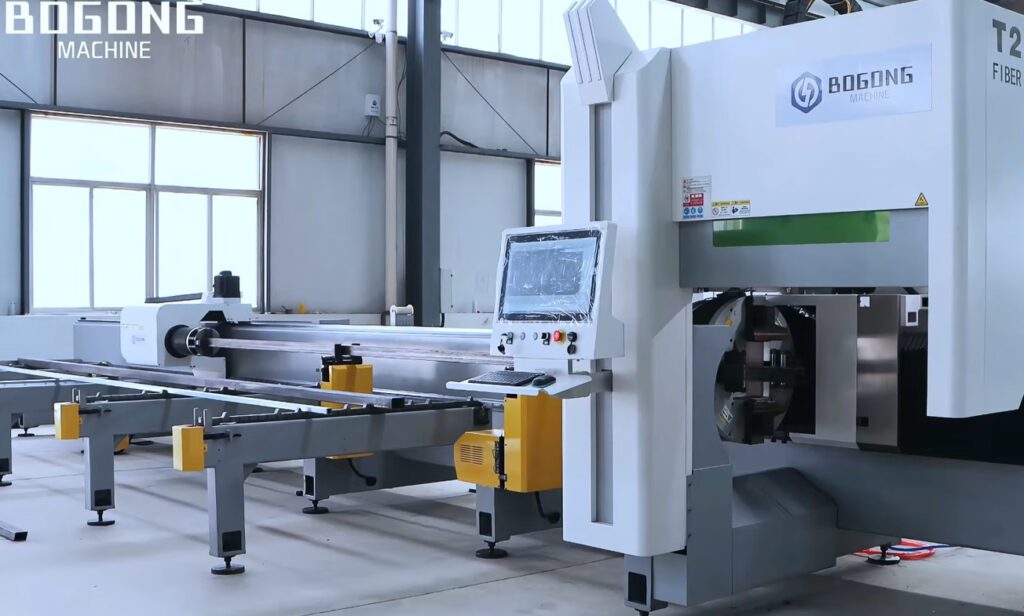
So yes, a standard fiber laser cutting machine can absolutely sit inside a modern factory. But from my experience, once labor pressure, throughput stability, and night-shift consistency become serious priorities, buyers start looking harder at setups like an automatic loading laser tube cutting machine. Because the ugly truth is simple: manual loading has killed more ROI stories than underpowered lasers ever did.
What smart factory buyers really want from laser cutting automation
They want numbers.
Not “innovation.” Not “future-ready excellence.” I’m sorry, but that language usually means somebody is compensating for a weak operations case. Real buyers want output per operator, scrap reduction, setup speed, uptime stability, edge consistency, and alarm data they can actually use. They want the machine to stop being mysterious.
And they want fewer excuses.
If I strip away the sales language, here’s what factories usually expect from laser cutting automation: predictable flow, faster turns, better sheet utilization, less operator dependence, fewer re-cuts, fewer “why did this happen?” moments, and some traceability when a complaint comes back weeks later. They don’t want magic. They want control.
That’s why laser cutting machines keep fitting smart-factory logic so well. They sit right at the point where digital planning turns into physical output—and if that handoff is handled well, the machine becomes part of a closed loop rather than a fancy bottleneck.
| Smart factory demand | What the laser system must deliver | What usually goes wrong |
|---|---|---|
| Real-time production visibility | Machine status, cut progress, alarms, OEE data | Machine runs fine, but data stays trapped in vendor software |
| Labor efficiency | Auto-loading, unattended shifts, faster setup | Manual loading erases the gains |
| Quality consistency | Stable beam, gas control, parameter recipes, edge quality | Operators keep “tweaking” settings without discipline |
| Flexible production | Fast nesting, short runs, mixed materials, quick changeovers | ERP and nesting software are not connected |
| Lower cost per part | Better sheet utilization, less rework, less downtime | Scrap and re-cut rates are not tracked honestly |
| Safety and compliance | Enclosures, interlocks, training, light barriers | Safety added later, not designed in |
And there it is.
The machine isn’t the whole purchase. The system is. Buyers who miss that end up blaming the cutter for problems caused by scheduling, loading, operator habits, or bad process discipline—what some shop-floor people would bluntly call “management scrap.”
The hard truth about Industry 4.0 laser cutting
Most factories aren’t there.
They’re halfway there. Maybe.
A few dashboards. A few machine screens. Some digital drawings. A software subscription nobody fully uses. And then everybody acts shocked when the so-called Industry 4.0 line still depends on one veteran operator who remembers which settings actually work on 5 mm stainless when the humidity gets weird.
Here’s the ugly truth: digitized is not the same as smart. Connected is not the same as controlled. And monitored is not the same as managed.
A real Industry 4.0 laser cutting setup does something much harder than “having software.” It links planning, execution, reporting, and reaction speed. Job comes in. Material is ready. Nest is right. Parameter library is locked down. Cut runs. Alarm data flows. Someone can actually see deviation fast enough to do something useful. That’s a loop. Most factories still have fragments.
Want proof that systems beat slogans? Look at the World Economic Forum’s 2024 Lighthouse examples. Foxconn’s Bắc Giang site used 40+ Fourth Industrial Revolution use cases and lifted labor productivity by 190%, hit 99.5% on-time delivery, and cut manufacturing costs by 45%. Siemens’ Erlangen electronics factory used more than 100 AI algorithms plus digital twins and improved labor productivity by 69%, cut time to market by 40%, and reduced energy use by 42%. GE HealthCare’s Beijing site used 45 digital solutions across 26 lines and cut cycle times and scrap by 66% while reducing customer complaints by 73%. That’s not showroom language. That’s operating leverage.
Now, no, those aren’t “laser-only” case studies. Exactly. That’s the lesson.
Laser cutting machines get stronger inside smart factories because they’re relatively easy to standardize, relatively easy to instrument, and relatively easy to connect to the rest of the production stack. But if the stack itself is weak—bad scheduling, poor material staging, fuzzy ownership, no one watching scrap honestly—the machine won’t save you. It’ll just reveal you.
A bit painful. But useful.
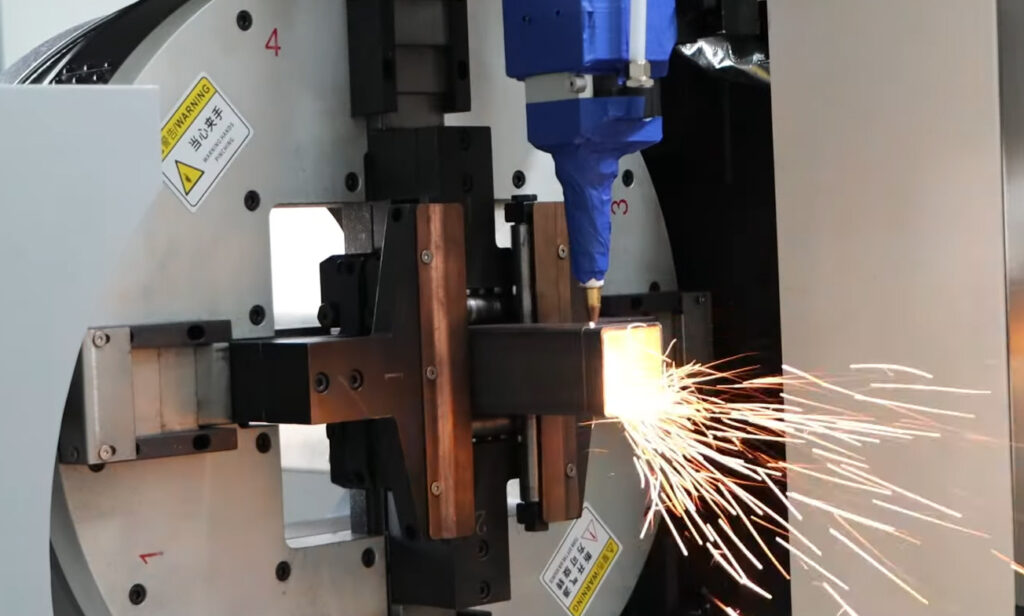
So when someone asks me for the best laser cutting machines for smart factories, I don’t start with wattage. I start with part flow, SKU churn, material mix, shift pattern, handling pain, nesting discipline, and whether the customer wants real data or presentation data. Those are two very different appetites.
Where fiber laser cutting in manufacturing earns its keep
On the hard jobs.
Not the easy demo cuts. Not the cherry-picked samples sales teams love. I mean real factory work: enclosures, cabinets, brackets, server chassis, tube components, panel parts, weld-prep pieces, mixed batch sizes, ugly scheduling windows, and customers who suddenly want the same part in three revisions and five materials by next Thursday.
That’s where fiber laser cutting in manufacturing makes sense.
It’s especially strong when you need speed plus repeatability plus digital control. Sheet metal shops know this. Electrical cabinet producers know this. Chassis fabricators know this. Anyone doing medium- to high-mix fabrication knows it too, even if they complain about consumables, assist gas, pierce settings, and all the other practical details outsiders rarely understand.
And yes, application fit matters more than brochure specs.
If bevel prep is eating time downstream, then a bevel fiber laser cutting machine for groove cutting and chamfering may solve a welding problem before the first tack. If the plant is juggling both sheet and tube with constant scheduling friction, an all-in-one metal sheet and tube laser cutting machine might make more operational sense than splitting work across scattered assets. And if the buyer is still trying to map actual use cases, the laser cutting machine applications page is a better starting point than obsessing over maximum power.
Because—this is important—more kW doesn’t automatically mean more money.
I’ve watched factories chase 12 kW, 20 kW, even bigger names, while the real limiter was unload time, poor nesting, or the fact that the parts came off the table faster than the shop could sort them. That’s not a laser problem. That’s cell design. Or, if we’re being blunt, a planning problem dressed up as an equipment problem.
Smart factory laser cutting is also a safety and management problem
Nobody loves this topic.
But they should.
As soon as you move toward automated loading, remote status checks, unattended shifts, and more aggressive output targets, safety stops being a compliance checkbox and becomes part of production architecture. That means guarding, interlocks, authorization levels, extraction, gas handling, maintenance discipline, and access logic all have to be treated like production variables—not legal afterthoughts.
I know that sounds dry. It isn’t. It gets real very fast.
A laser protective fence isn’t decorative. It’s part of how a serious factory manages risk when a cutting cell is expected to run hard and run consistently. Same goes for enclosure design, lockout behavior, maintenance access, and whether operators are quietly bypassing procedures because the process was set up in a way that makes the “safe” path slow and annoying. That happens too.
And then there’s software.
Everyone wants AI in manufacturing right now. Of course they do. But Reuters reported in July 2024 that manufacturers were rolling out planned generative AI projects more slowly than expected because of accuracy worries; 58% of manufacturing leaders planned to increase AI spending in 2024, but only 20% of planned AI projects had actually been implemented in the prior year. Forty-four percent of manufacturing respondents cited response accuracy concerns. Honestly, that caution sounds healthy to me. A plant can survive bland software. It can’t afford confident nonsense near live equipment.
So yes, smart factory laser cutting needs software. But not theater software. Not dashboard wallpaper. It needs systems that are accurate, auditable, floor-aware, and boring in the best possible way.
Reliable beats flashy.
Every time.
What a serious buyer should measure before signing
Start here.
Part mix. Material range. Sheet thickness. Tube share. Assist gas cost. Nozzle consumption. Setup time. Handling time. Unload flow. Scrap visibility. Re-cut rate. Operator skill spread. Software compatibility. Maintenance response. Safety design. That’s the shopping list.
And I’d add one more thing most buyers ignore: decision lag.
How long does it take your plant to notice that the laser cell is drifting, backing up, throwing rejects, or sitting idle because the next nest wasn’t released properly? Ten minutes? Two hours? Monday morning? That answer tells you more about your smart-factory maturity than any sales presentation ever will.
From my experience, the best laser cutting machines for smart factories are not the ones with the prettiest spec sheet. They’re the ones that fit the factory’s actual production metabolism—the pace, the handoffs, the part family, the staffing reality, the ERP mess, the maintenance culture, all of it. If the machine fits the work, it wins. If the machine outruns the system, the system punishes it.
Why laser cutting machines will stay central to modern factories
Because they keep scaling.
Not effortlessly. Not cheaply. And not without headaches. But they scale better than a lot of competing fabrication methods when the plant needs precision, throughput, recipe control, flexible routing, and a straight path into automation.
That’s why they aren’t going anywhere.
Global automation density keeps climbing, leading plants keep proving that tightly integrated digital production can deliver hard gains, and laser cutting remains one of the cleanest bridges between digital instruction and physical output. That bridge matters. Especially now. Especially when customers want faster turns, more revisions, and cleaner quality records without paying for chaos.
And there’s the simplest truth of all: in a modern factory, ambiguity is expensive. Laser cutting machines reduce ambiguity. They cut what the file says, if the file is right, the setup is right, and the system around them isn’t broken. That’s exactly why smart factories keep pulling them closer to the center.
FAQs
How do laser cutting machines improve smart factories?
Laser cutting machines improve smart factories by converting digital production instructions into repeatable, traceable parts while feeding operating data—such as machine status, cut progress, alarm history, and throughput—into connected software systems that support scheduling, maintenance, quality tracking, and production visibility across the factory. That’s the clean answer.
The longer answer is more practical. They help plants cut down setup drag, standardize quality, support short runs, and expose waste that older processes often hide. If connected properly, they don’t just make parts—they make problems visible sooner.
What is the difference between a standard CNC laser cutter and a smart factory laser cutting system?
A standard CNC laser cutter is a programmable cutting machine, while a smart factory laser cutting system is a connected production unit that exchanges useful data with planning, quality, maintenance, and material-handling systems to improve output consistency, traceability, and reaction speed across the broader manufacturing process. That’s the distinction.
In plain language, one machine cuts. The other participates. A smart-factory system can support recipe locking, automated loading, job prioritization, status alerts, traceability, and tighter links to bending, welding, or packing. Same beam, very different operating logic.
Are fiber laser cutting machines the best option for modern smart factories?
Fiber laser cutting machines are often the best option for modern smart factories when the core work involves metal fabrication, high throughput, variable batch sizes, tight tolerances, and a need for stable integration with automation and digital production systems across sheet or tube processing workflows. That’s usually the answer.
But not always. If your factory still struggles with loading, scheduling, or material staging, the machine won’t fix that by itself. Fiber is powerful—but it works best when the rest of the cell isn’t chaotic.
What should buyers check before choosing the best laser cutting machines for smart factories?
Buyers should check part families, material types, sheet and tube volumes, automation goals, software compatibility, gas and energy costs, safety requirements, service support, and actual handling bottlenecks before choosing the best laser cutting machines for smart factories, because machine value depends heavily on production flow and system discipline. That’s the shortlist.
I’d also push buyers to verify real integration capability. Not just installation. Ask whether the vendor can support alarm reporting, recipe control, MES links, unattended-shift safeguards, and usable production data. If they can’t, the machine may still cut well—but it won’t truly behave like part of a smart factory.
Your next step
If you’re evaluating laser cutting machines for a modern smart factory, don’t begin with “How much power do we need?” Start with a harsher question: where does the factory lose control today? Material release? Loading? Scrap visibility? Re-cut rates? Scheduling lag? Operator variance? That’s where the buying logic should begin.
Then narrow the machine around the reality.
If you want practical options to compare, review Bogong Laser’s fiber laser cutting machines, look at its automatic loading tube cutting systems, and factor in laser protective fence solutions before you treat the cell like a finished answer. It isn’t. A smart factory is built through disciplined choices—one linked decision at a time.


Hot Click
Contact Us
Application
©Copyright [bogonglaser.com]. BOGONG Laser Machine Supplier All Rights Reserved.